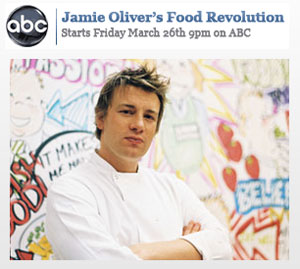
Jamie Oliver has brought over from the UK a notion that I strongly believe in. I remember reading a position paper by the American Dietetics Association that spoke about three key ways that one can have a healthy diet. These were variety, moderation, and balance. Jamie's idea of healthy eating follows this notion. On his website he talks about how food is too often seen as an evil thing that people tend to shy away from. Jamie argues that with proper cooking skills, and a general knowledge of nutrition, one can easily have a well balanced diet that will allow room for the occasional sweets.
Ever since first year FNN 100 I have been preaching this notion that a healthy, well BALANCED diet does not have to be bland. It does not mean that eating a few chocolates is wrong. I admit, I have the occasional cravings for McDonald's fries, coca-cola, and Kit Kat Chunky, and when I do, I MUST have it. If not, I'll think about it until I can get my hands on the "bad" food item I am craving. People are sometimes shocked when they look at the foods that I sometimes choose to eat. The other day I bough a bag of chips from the vending machine at work. My coworkers were all confused because they all know that I am currently in a nutrition program. The way I see it tho, is that the food I consume must be good for the body as well as the mind. After all, it was my love for food that brought me to Ryerson.
Last month I wrote about the importance of shrinking the gap between those with nutrition knowledge, and those with cooking skills. Jamie Oliver, although not formally educated in nutrition, was able to see a problem in the UK school food system and used his status as a celebrity chef to address these issues. Jamie is someone who has an excellent idea as to how to implement a new health promotion program in a community.
In a new TV show called "Jamie Oliver’s Food Revolution", Jamie visits American cities in hope of educating Americans on making healthy food choices, especially in the school system. In the first episode, Jamie spents some time in Huntington, West Virginia, that was recently called America's unhealthiest city. He was faced with a lot of criticism and hate. People didn't want him there, and they couldn't wait to see him fail. So far I have only seen the first episode of "Jamie Oliver’s Food Revolution", so I don't know what will end up happening, but I hope that he has the ability to create the kind of change in America as he did in the UK. I know that my view on the people of Huntington is biased, as very agreeable, easy to get along with people don't make for high TV ratings, but I will continue to watch this show to see how Jamie is able to cause a change in a city full of people who seem stubborn and unwilling to change.
Jamie's idea of going into the community that you are trying to help is a fundamental concept in program planning. One must spend time getting to know and understand the community in order to create programs that has relevance to them. I hope that by giving people the knowledge and skills in healthy cooking, they will feel empowered to cook healthy, tasty meals. In my previous blog I mentioned that healthy cooking doesn't have to taste bad, but what I didn't realize is that I do not have the cooking skills to create healthy, tasty meals.
Last month my friend baked my aunt an apple pie. It ended up being one of the worst pies I ever tasted, not because my friend was a bad chef, but because of the changes that I asked him to make. I basically butchered his recipe so that it was "healthy". While he was making it, we had many arguments. I told him to cut the sugar, he argued that it wouldn't taste good. I secretly think that he eventually became tired of arguing and purposely made the pie taste bad so that I would stop nagging. I don't know whether or not this is true, but I hope programs such as family studies (which some know as Home Economics) is incorporated back into the school system. I learned of my love for food and nutrition through my family studies classes that began in grade 7. One of my classmates from middle school told me that ever since she could remember, I wanted to do something with nutrition. I would talk about it, and I would write about it. I would hate to hear of a young adolescent never learning about their passion for food and nutrition because they never had the opportunity to learn about what nutiriton and food has to offer.